

Ever since the Ethereum Name Service (ENS) was launched in 2017, Web3 users have been able to replace the long strings of characters that make up a crypto address with a more easily memorized blockchain username or Web3 domain name. For example, Ethereum users can now send crypto to the network’s founder, Vitalik Buterin, at his username, vitalik.eth, without knowing that his address is 0xd8da6bf26964af9d7eed9e03e53415d37aa96045.
But despite this advancement making it much easier to identify users, hardly anyone has taken advantage of it. There are over 200 million unique addresses on Ethereum, yet only 2.2 million .eth names were registered as of January. This means that at least 97% of Ethereum addresses are not associated with an ENS username.


This lack of usernames creates user experience problems in the Web3 ecosystem. Just imagine if early email addresses had consisted of long strings of characters that looked like 0x7a16ff8270133f063aab6c9977183d9e72835428 or 0x3A7937851d67Ee2f51C959663749093Dc87D9C9a. If this had been the case, email may not have survived as a practice.
But despite this initial lack of adoption, there is some evidence that the tide may be turning in favor of Web3 usernames. A few recent advancements in wallet and messaging apps may onboard more users than ever before.
One of these advancements is better wallet integration with free usernames.
Wallet integration and free usernames
Wallets have had the ability to understand Web3 names for a long time. According to MetaMask’s changelog, it introduced the ability to send to a .eth name in October 2017, right after ENS launched. Other wallets have followed suit with this feature, including Coinbase Wallet, Trust Wallet and others. Some of these wallets have also integrated with ENS rivals Unstoppable Domains, Space ID, Bonfida and others.
However, these wallets still show a crypto address to users by default, as new users don’t typically receive names automatically.
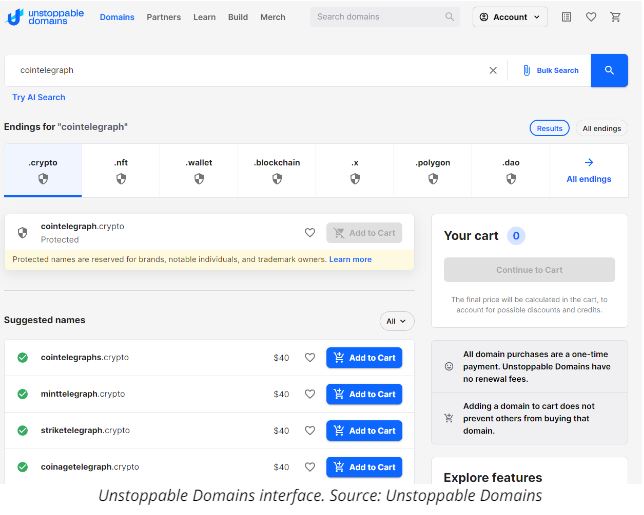
For a user to receive crypto via their Web3 name, they need to first register a username with a particular name provider. This means figuring out which provider to use, navigating to the provider’s interface and going through the registration process.
To make matters worse, names can be expensive. ENS names typically cost $5 and expire after a year, while Unstoppable Domains names that do not need to be renewed typically cost from $20–$40. Compare this with how easy it is to sign up for an email address for free using Gmail, Outlook or Yahoo, and it’s easy to see why most crypto users don’t have a Web3 username.
A few wallet apps have been trying to solve this problem by giving away free domain names to their users. For example, Coinbase Wallet allows new users to register a single .cb.id username for free once per year, and Kresus wallet offers its users a free .kresus username of up to eight characters.
This practice of giving out free usernames has begun only recently. And some popular wallets like Trust Wallet and MetaMask still don’t offer the feature. But as more users onboard to the Web3 ecosystem, this may lead to greater adoption of Web3 usernames over time.
Another recent advancement is instant messaging integration.
Chat messaging with Web3 usernames
Some messaging apps have begun implementing Web3 names as usernames, increasing these names’ utility beyond the payments use case. One example is Blockscan Chat, which allows users to send instant messages to any Ethereum address or ENS username.
Messages that are sent using Blockscan Chat produce alerts on the Etherscan block explorer. If the recipient sees the alert and logs into the app, they can read it. The app’s developer claims that all of its messages are end-to-encrypted. So, although anyone can see if a particular user has received a message, only the sender and recipient can read it.
Web3 usernames aren’t an absolute necessity for using Blockscan Chat, as it does allow users to send messages to crypto addresses. But names do make it much easier for users to find each other in the app.
Another example is Grill.chat, a messaging app running on the Subsocial network. When a user first signs up for it, they are assigned a random username. But they can optionally attach an Ethereum wallet to their account. If they do this, the app automatically converts their random username into their .eth username.
Being able to find other users to chat with via their Web3 usernames is arguably a more useful feature than being able to send crypto with them.
After all, the crypto community is still small. If a crypto user needs money from friends or family, they may be better off using traditional Web2 apps like Venmo or Apple Pay, as their friends and family may not know how to use a Web3 wallet. But if a person wants to chat specifically about crypto and Web3 apps, being able to look them up by their username could turn out to be a huge advantage. This added use case may entice more users to adopt Web3 names in the future.
Another recent advancement in Web3 names is cross-chain names.
Cross-chain Web3 names
When Web3 names were first invented, ENS was the only protocol that could be used to create them, and it could only be used on Ethereum.
But the Web3 ecosystem has since grown to encompass many different chains. And as the number of chains has grown, so has the number of naming protocols. Users can now register Polygon usernames from Unstoppable Domains, Solana ones from Bonfida, and both Arbitrum One and BNB Chain names from Space ID.
This fragmentation across chains can make integration difficult for wallets and block explorers, and confuse users. For example, suppose a person’s Polygon username is newton.crypto. But when they go to register the same name on BNB Chain, they find that newton.bnb is already taken, so they register einstein.bnb instead. When a user looks at this person’s address on a block explorer, either name could appear, depending on which one the developer of the block explorer has chosen to display. And regardless of which one is displayed, it could confuse users.
In this case, for example, if a user wants to send crypto to newton.crypto via BNB Chain, they may easily send it to newton.bnb instead, which will turn out to be the wrong recipient.
A few Web3 companies are trying to fix this problem by creating a single name for each identity across multiple chains. For example, the Redefined app allows users to register for a username on Arbitrum One and use it to receive funds on Optimism, Polygon, BNB Chain, Solana, Bitcoin, Moonbeam, Near, or any EVM-compatible chain.
To make this feature possible, the Redefined app lets the user write an address or username for each network into the Arbitrum smart contract through a “manage” tab within the app. Once the addresses are listed in the contract, any person can initiate a transaction to the correct address using a “send” function within the app. To send funds, the sender only needs to know the recipient’s Redefined username, not the recipient’s name or address on any particular chain.
Redefined usernames begin with an @ and do not have extensions. For example, @newton and @einstein are possible Redefined usernames. The protocol also features an aggregator SDK that wallets and other apps can use to integrate with these usernames.
Did.id, also called “.bit,” is a similar project that runs on the Nervos Network. It allows users to register for a .bit username that works across 39 different networks, including Bitcoin, Ethereum, Polygon, Solana, Bitcoin Cash, Internet Computer and many others. Registration can be done directly with a Nervos Network wallet or indirectly using Polygon.
Did.id doesn’t feature a user interface with a “send” function. However, it is integrated with nine different wallet apps, including imToken, Tokenpocket, MathWallet, Huobi Wallet, Bitkeep, HyperPay, AlphaWallet, ViaWallet, and MIBAO. So it’s available to senders who use these wallets.
Cross-chain usernames are yet another new development that may spur greater adoption of Web3 usernames over time.
When will usernames catch on?
Despite these advancements, it’s still not clear how long mass adoption of Web3 usernames will take. Right now, over 90% of Web3 addresses are not associated with any username. So there is a huge hill to climb in terms of adoption. And in the meantime, users still need to cut and paste a complicated string of characters to find a person’s Web3 identity.
There is also still plenty of friction left for users, including the continuing high cost of registering a name for users of most wallet apps.
Even so, these advancements may pave the way for the mass adoption of Web3 usernames at some point in the future.